BOTTOM LINE:
Custom court striping gives Fort Worth athletic facilities more flexibility, cleaner multipurpose layouts, and a stronger visual identity than standard marking packages. Done correctly, it also extends the life of the court surface by protecting the coating beneath — and it communicates that a facility takes its players and programming seriously.
Court striping is easy to undervalue until you see how much better a well-executed layout performs.. A freshly coated court with crisp, accurate, well-designed markings reads immediately as a professional facility — one that was built with intention. The same court with faded, misaligned, or cluttered lines from multiple sports stacked on top of each other reads as neglected, regardless of how good the surface underneath actually is.
In Fort Worth, where parks departments, school districts, private clubs, HOAs, and commercial facilities are all investing in outdoor athletic courts, custom striping has become one of the clearest ways to improve function and distinguish a court visually. Here is what custom striping actually involves, why it matters more than most people initially think, and what facility managers should know before the paint goes down.
What Custom Striping Actually Means
Standard court striping packages — the default layouts that come with a new court installation or a resurfacing job — are designed to cover the most common use case for that court type. A basketball court gets the standard NBA or FIBA key dimensions. A tennis court gets the standard singles and doubles lines. That works fine for a single-sport facility where the layout is fixed and the user base is consistent. It does not work as well for a multipurpose court that needs to serve different sports across different user groups throughout the week, or for a facility that wants to reinforce its brand identity through the court design itself. Professionally executed athletic court surface coatings in Fort Worth that include a custom striping plan from the start produce a far better result than standard packages applied after the fact.
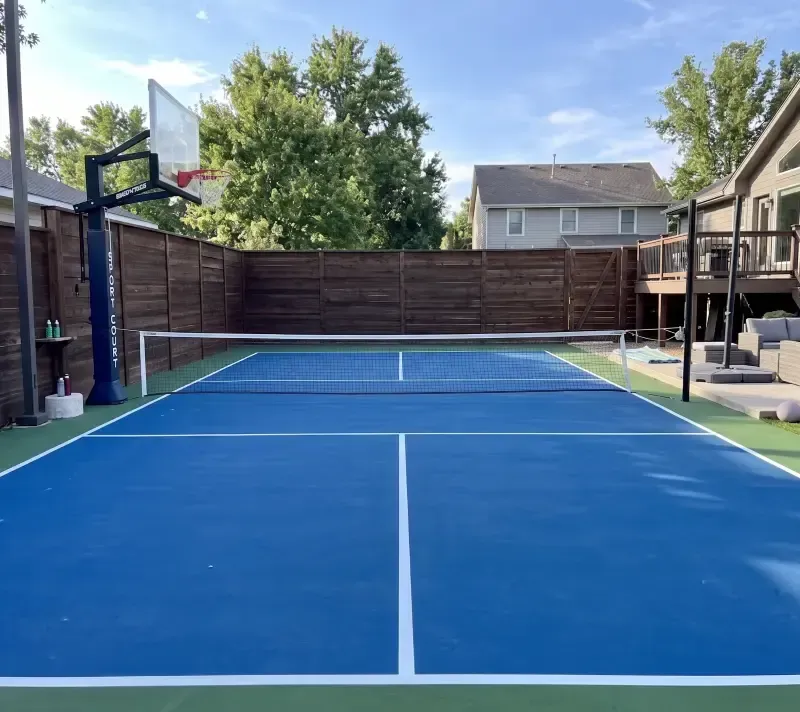
Custom striping addresses both of those limitations. It means designing the court markings from scratch around the actual sports, dimensions, and user groups the court will serve — rather than applying a template and working around whatever does not fit. It also opens up design choices around line color, line width, sport zoning, and branding elements that simply are not available in a standard package.
The Multipurpose Court Problem — and How Custom Striping Solves It
Multipurpose courts are one of the most common requests from Fort Worth facilities, and they are also one of the most commonly done poorly. The challenge is straightforward: multiple sports have different court dimensions, different line configurations, and different color conventions, and trying to stack all of them on a single surface without a clear plan produces a court where no sport is well served and players spend half their time figuring out which lines apply to them.
Custom striping solves this by using color differentiation strategically. Assigning a distinct line color to each sport — red for basketball, white for tennis, blue for pickleball, for example — allows players to immediately identify the lines relevant to their game without confusion. When the colors are chosen with contrast in mind and the court surface color is selected to work with all of them, the result is a multipurpose court that reads cleanly for each individual sport despite carrying the markings of several.
Line width is another variable that custom striping can use to reduce visual clutter. Primary boundary lines for each sport can be marked at full width while secondary lines — service boxes, lane markings, three-point arcs — are marked at a narrower width that distinguishes their function visually. This hierarchy of line weight makes the court easier to read during play without reducing the accuracy of any individual marking.
Accuracy: Where Custom Striping Earns Its Keep
Standard striping templates are accurate in theory but they are only as accurate as the installation in practice. A template that is not carefully set and measured before marking begins produces lines that are geometrically correct in the template but positioned incorrectly on the actual court. On a new court with square corners and clean reference points this is manageable. On an existing court with slight variations in dimension, irregular shape, or a baseline that is not perfectly parallel to the opposite baseline, template-based striping regularly produces visible problems.
Custom striping done by an experienced crew starts with careful measurement of the actual court before any layout decisions are made. The markings are designed to fit the court as it actually exists, not as it theoretically should be. On courts that serve competitive play — where players are accustomed to specific dimensional expectations and will notice when something is off — this accuracy is not a luxury, it is a requirement. At Fort Worth Concrete Contractors, Lahi Kautai and the team approach court striping with the same precision they bring to structural concrete work — measuring carefully, checking twice, and not starting the paint until the layout is confirmed correct. It takes more time upfront, but it produces a court that does not need to be redone later.
Branding and Visual Identity
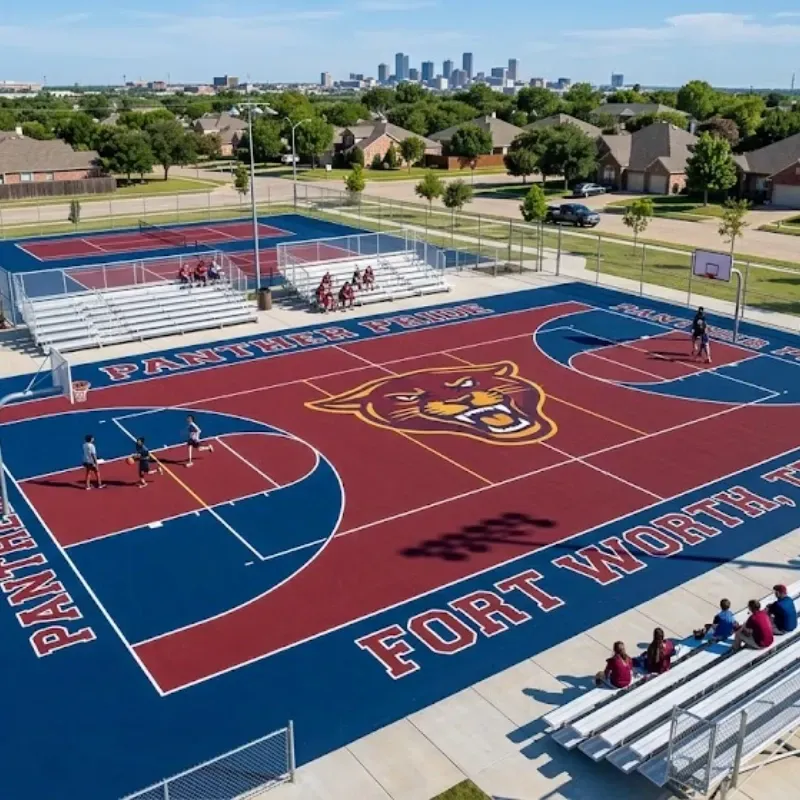
Custom striping is also one of the most cost-effective ways a facility can reinforce its identity. School districts in Fort Worth increasingly use court striping to incorporate school colors, mascot logos at center court, and school name markings that communicate institutional pride and transform a generic athletic surface into something that feels like it belongs to a specific community. Private clubs and HOA facilities use similar approaches to create a premium feel that differentiates their amenity from a standard concrete slab with paint on it.
Center court logos in particular have become popular in Fort Worth facilities because they add visual anchor to the court and make it photograph well — a practical consideration in an era where facilities are regularly featured on social media and in marketing materials.
A court that looks professional in photos attracts more users and creates more value for the facility than one that looks utilitarian, and the cost of a custom logo at center court is modest relative to the impression it creates.
Color selection for branded courts requires some care. The court surface color, the line colors, and any logo colors all interact visually, and combinations that look appealing on a color swatch do not always translate as intended once they are scaled to a full court surface under Texas sunlight. Working through the color scheme with someone who has executed branded court projects before — and who can show examples of finished work in comparable conditions — produces better outcomes than making color decisions in isolation.
When to Stripe: New Installation vs. Restripe
The best time to finalize the striping plan for any court is before the surface coating goes down, not after. Line color selection affects surface color selection, and the relationship between them determines how readable the court will be in actual playing conditions. A facility that chooses the surface color first and then tries to find line colors that work with it sometimes ends up with combinations that look fine in theory but create contrast issues under direct sun or in low light conditions.
For existing courts that need a restripe without a full resurfacing, the process involves cleaning the surface thoroughly, applying line tape to mask the new markings accurately, and applying quality court marking paint in sufficient coats to cover any residual color from previous lines. Old lines that were not fully covered in a previous restripe can ghost through new paint if the coverage is insufficient — a problem that shows up clearly once the tape is removed and the court is in use. Doing the coverage properly is worth the extra coat of paint.
For facilities combining striping with broader resurfacing or repair work, coordinating court-related concrete work in Fort Worth helps sequence each phase correctly from crack repair through final markings.
Getting the Striping Right the First Time
The most common striping mistakes — misaligned lines, colors that do not contrast adequately, multipurpose layouts that are too cluttered to read clearly, or logos that are positioned off-center — all share a common cause: insufficient planning before the paint goes down. Striping that is done carefully, with the layout fully designed and confirmed before application begins, almost always comes out correctly the first time. Striping done without a proper layout plan almost always looks rushed because it was rushed.
For any court serving competitive play or representing an institutional identity, getting a professional set of eyes on the striping plan before committing to it is worth the time. Dimensions that look correct on a drawing do not always play correctly on a court of slightly different scale, and color combinations that look good in a swatch book sometimes read differently on 4,000 square feet of outdoor surface under Texas sun. Experience with what actually works in practice is what bridges that gap.
For facilities that are selecting a contractor for court striping and want to understand what separates high-quality work from adequate work, our article on choosing the right concrete contractor in Fort Worth covers the questions and evaluation criteria that help facility managers make a well-informed decision before the project begins.
.

Written By:
Domenique Bomediano
Home Improvement Research Specialist
Domenique Jose Bomediano produces research-focused educational content on home renovation, construction, concrete services, and property improvement. He translates technical concepts, contractor workflows, and industry practices into clear, practical insights that help homeowners make informed decisions about projects, budgeting, and property planning.